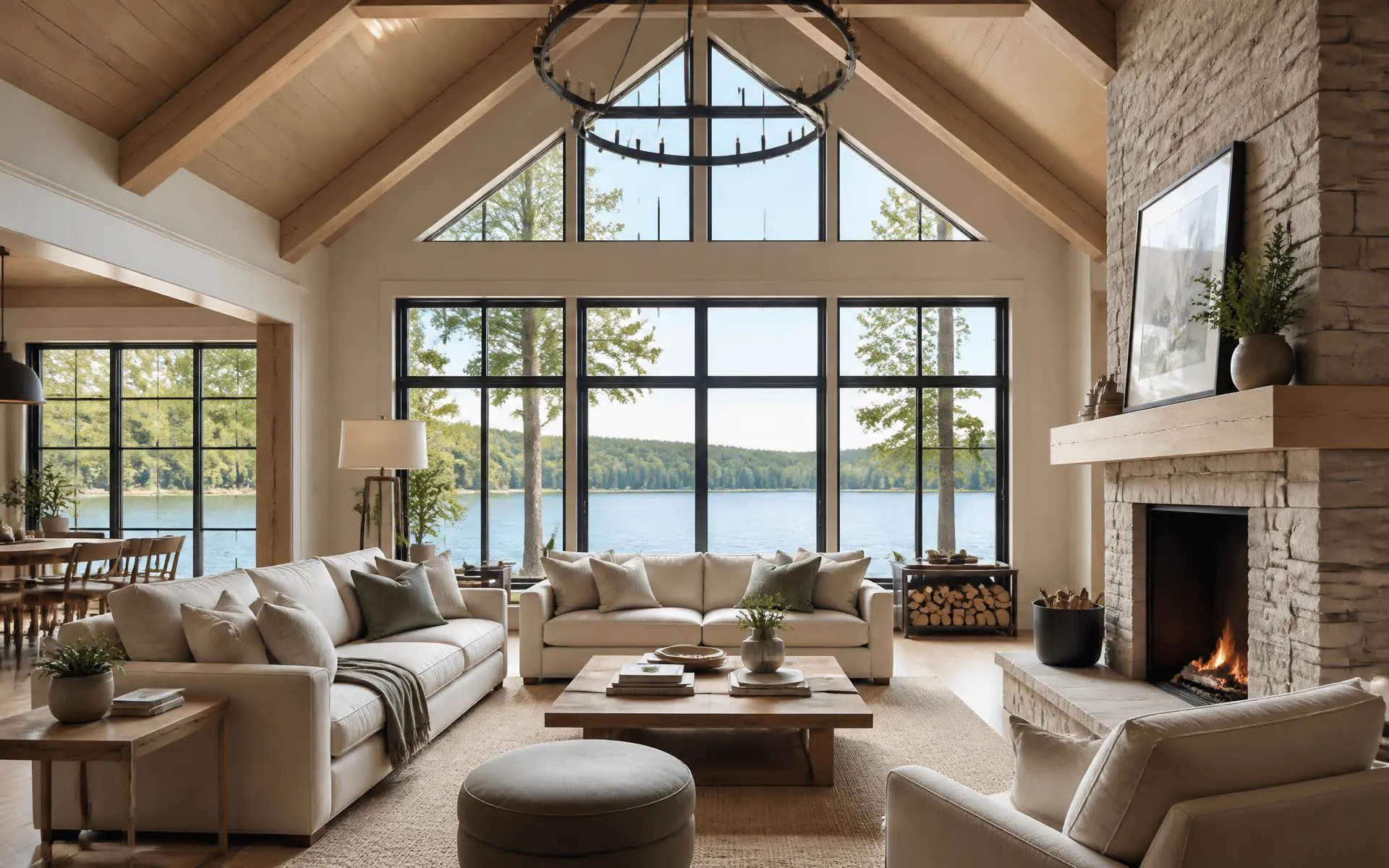
Big light, wet feet, and eleven people on a Saturday. Design for that, not for the photograph.
Lake interiors fail in predictable ways: fabrics that fade under western glare, floors that cannot handle water, and a layout that seats six in a house that regularly holds fifteen. Everything below is a reaction to those three failures.
Light first
Water reflects light upward, so lake rooms are brighter and cooler than equivalent rooms inland. Whites go blue; warm neutrals, oak, limestone, and soft clay tones hold their character. Test every finish in the actual room, at the actual hour you will use it.
A palette that belongs
Take the palette from outside the window: hardwood green, water grey-blue, sand, and weathered oak, with a single warm metal running through. Nautical themes date instantly; the landscape does not.
Materials
Performance textiles and solution-dyed outdoor fabrics used indoors.
Wide-plank engineered oak, or large-format porcelain on lower levels.
Honed rather than polished stone — water spots less visible, safer wet.
Unlacquered brass and blackened steel; both improve as they age.
Layout for the way lake houses are used
Oversized seating groups rather than formal ones. A second refrigerator and a real prep zone. A dedicated wet entry from the dock with a place for towels, life jackets, and shoes. Bunk rooms earn their footprint. Outdoor living deserves the same finish budget as the great room.
Art and objects
Restraint reads as luxury in a room with a view this strong. Fewer, larger pieces; nothing that competes with the window wall.
The network
The people we build with
One group covers the whole arc of a lake property: find it, build it, finish it, wire it. Everything else, we refer out.
Estate-level custom building for lake and near-lake sites — from shoreline grading and foundation engineering to millwork and final punch. The team that gets a house onto a difficult Catawba lot without fighting it.
Licensed North Carolina brokerage covering the Mountain Island Lake corridor across Mecklenburg, Gaston, and Lincoln counties — including the off-market waterfront that never reaches a public feed.
Interior design built for lake light and lake life: durable natural materials, restrained palettes, and rooms that hold up to wet feet, big sun, and long weekends full of people.
Whole-home control, outdoor and dock audio, shoreline-grade Wi-Fi, lighting, shades, and surveillance — designed during framing, not bolted on afterward.
Beyond the shoreline itself, the wider Charlotte market — neighborhoods, relocation, and everyday buying and selling — sits with Peters Team Realty. For anything outside the group, the wider network covers the trades and services this lake tends to need.