Shoreline
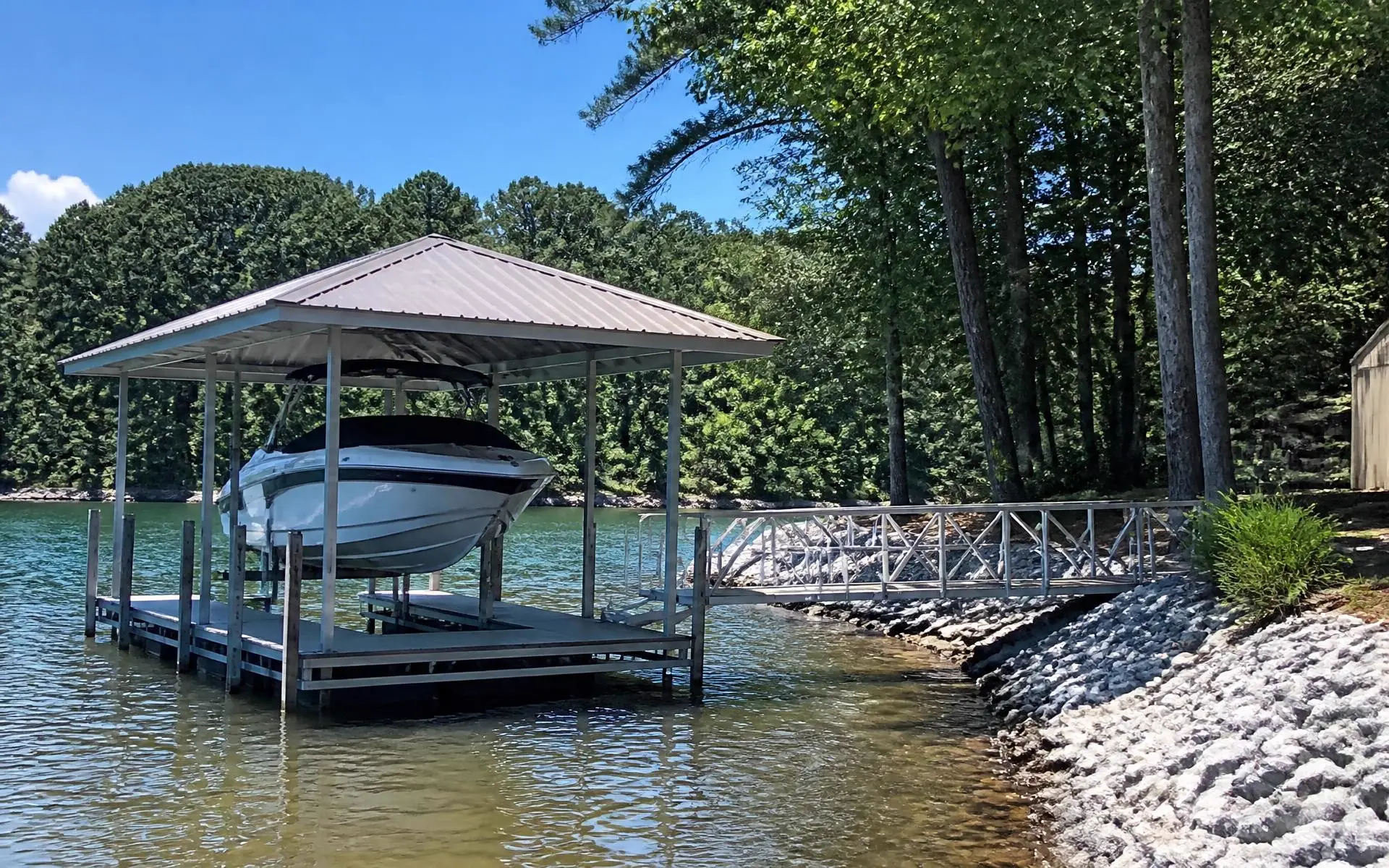
Docks, piers, and the permit that governs them
Water frontage is not the same thing as dock rights. On this lake the difference is worth six figures.
Mountain Island Lake is a licensed Duke Energy hydroelectric project. Everything that touches the water inside the project boundary — a pier, a floating dock, a boat lift, riprap, a set of steps, even significant vegetation removal — is governed by Duke Energy's Shoreline Management Program, not by the county and not by the homeowner.
What requires approval
Activity inside the project boundary
- New pier or dock
- Permit required. Approval depends on shoreline classification, water depth, adjacent-owner setbacks, and available frontage.
- Replacing or enlarging a dock
- Treated as new construction; grandfathered structures do not carry unlimited replacement rights.
- Boat lifts and personal-watercraft lifts
- Permitted as an attachment to an approved structure, not independently.
- Shoreline stabilization
- Riprap, seawalls, and bank repair require approval and an engineered approach; unpermitted rock is a violation.
- Excavation and dredging
- Rarely approved, heavily conditioned, and never something to assume when a cove is shallow.
- Vegetation removal
- Buffer clearing is limited. Access corridors are narrow and defined; clearing to open lawn is generally not allowed.
Why some lots will never get a dock
Shoreline is classified, and classification controls use. Land designated for environmental, natural, or public-use purposes does not support private structures regardless of who owns the upland. Beyond classification, three physical constraints disqualify lots on this lake more often than buyers expect: insufficient water depth at low pond, insufficient linear frontage once adjacent-owner setbacks are applied, and a project boundary that sits well upland of the waterline, leaving a strip of Duke-managed land between the yard and the lake.
The order of operations
- Pull the parcel and confirm where the project boundary falls relative to the deeded property line.
- Request the shoreline classification for that specific frontage.
- Ask Duke Energy Lake Services whether an existing structure has a current, transferable permit on file.
- Measure depth at the proposed dock location at low pond, not on a full-pond summer afternoon.
- Confirm county and watershed requirements separately — Duke approval does not substitute for local permitting.
- Make the answer a written contingency in the contract.
How this shapes value
Because the lake is narrow and much of the shoreline is protected, permitted deep-water dock rights are the scarcest attribute in the market. Two houses of identical size a quarter mile apart can trade far apart in price on dock status alone. That scarcity is also why waterfront inventory turns slowly and why comparisons with Lake Norman rarely translate directly.
Related reading: boating and public access, watershed rules that limit clearing, and building on a shoreline lot.
Answers
Questions & Answers
- Do I need a permit to build a dock on Mountain Island Lake?
- Yes. Mountain Island Lake is a licensed Duke Energy hydroelectric project, and any structure inside the project boundary — pier, floating dock, boat lift, riprap, steps, or significant vegetation removal — requires approval under Duke Energy's Shoreline Management Program. County permits do not substitute for it.
- Source: Duke Energy — Mountain Island Lake lake services and shoreline management
- Does every waterfront lot on Mountain Island Lake qualify for a dock?
- No. Approval depends on the shoreline classification assigned to that frontage, water depth at low pond, the amount of linear frontage remaining after adjacent-owner setbacks, and where the project boundary falls relative to the deeded property line. Land classified for environmental, natural, or public use does not support private structures.
- Source: Duke Energy — Mountain Island Lake lake services and shoreline management
- Is an existing dock automatically transferable when I buy the house?
- Not automatically. Confirm in writing with Duke Energy Lake Services that a current permit exists for the structure as built and that it transfers to a new owner. Unpermitted or altered structures become the buyer's problem at closing.
- Source: Duke Energy — Mountain Island Lake lake services and shoreline management
Keep reading
Continue the guide
Boating on Mountain Island Lake
Public ramps, no-wake reality, dock permits, and the lake's quiet-water culture.
Waterfront Homes on Mountain Island Lake
Dock rights, cove vs. main channel, and waterfront due diligence.
Mountain Island Lake Water Quality
Why this reservoir is Charlotte's drinking water — and what that means for owners.
The Mountain Island Lake Guide
The lake itself — 3,281 acres, 61 miles of shoreline, and how it works.
More in The lake
- Lake Access: Ramps & Launches
- Mountain Island Lake Facts
- Latta Plantation
- Parks & Nature at Mountain Island Lake
- Latta Nature Preserve
- Kayaking Mountain Island Lake
- Boat Ramps on Mountain Island Lake
- The Catawba River
- Water Level & Full Pond
- Fishing Mountain Island Lake
- Mountain Island Dam & Hydro Station
- Swimming in Mountain Island Lake
- Lucia Access Area
- Water Temperature
- Parks on Mountain Island Lake
- History of Mountain Island Lake